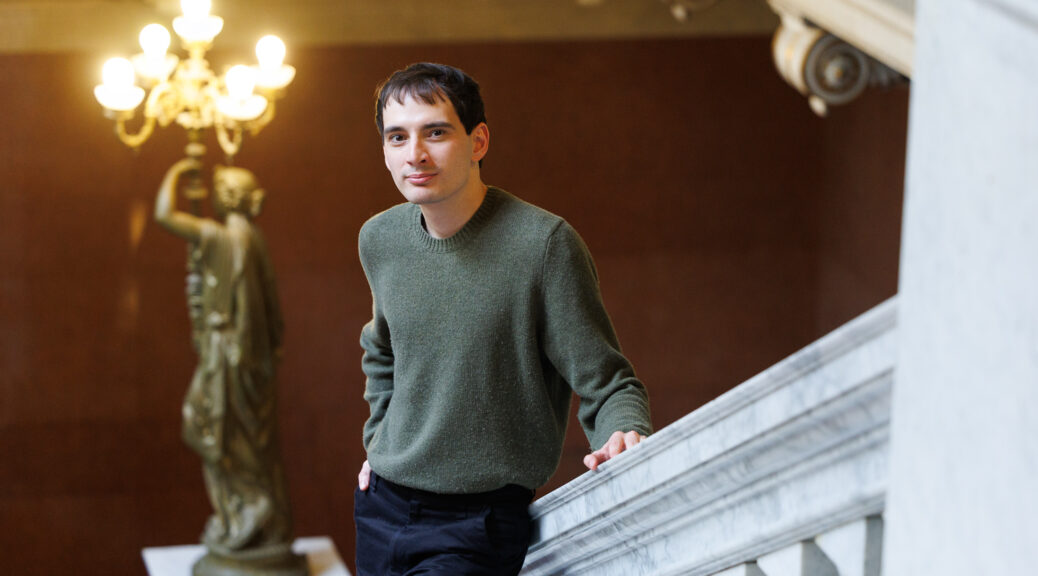
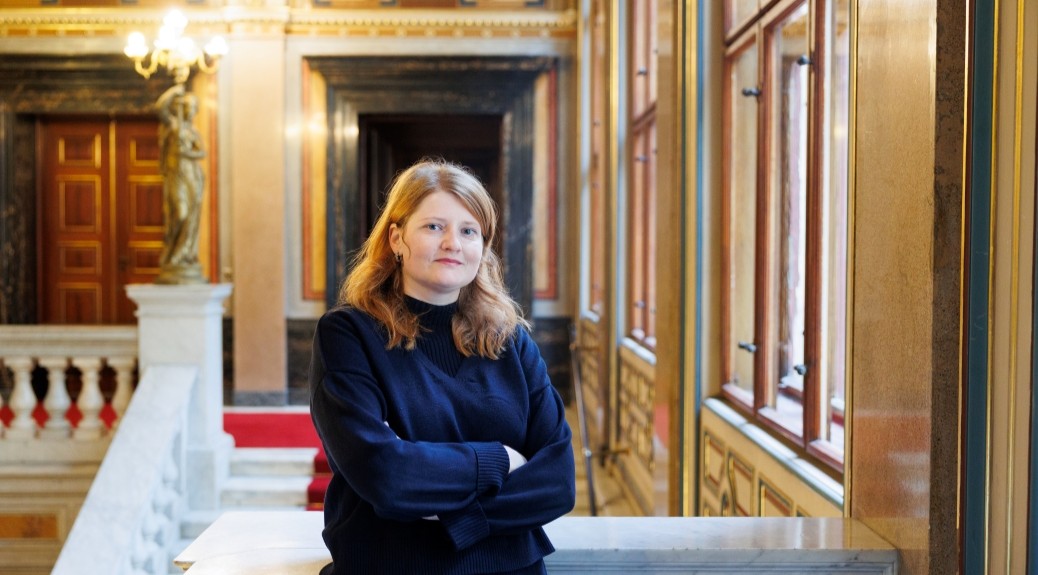
The Student Support Fund was created to attract talented students to CERGE-EI and enable them to focus fully on their studies. In 2019, two students became the first recipients of the Alumni Excellence Fellowship—one of them was Maksim, who is now completing the PhD program and entering the international academic job market.
Five years later, we look back at what the Fellowship meant for him, how it shaped his development at CERGE-EI, and why alumni support continues to play a crucial role for future generations.
When Yaroslav Korobka, a CERGE-EI student with a deep passion for econometrics, received the unexpected suggestion “Princeton” during his DPW defense, it opened a path he hadn’t fully imagined. His mobility stay at Princeton University became a defining academic experience—shaping his research, expanding his network, and transforming both his skills and perspective. In this interview from the series Places You’ll Go, he shares what surprised him most about the teaching environment and the lessons he brought back for future CERGE-EI students.Continue reading “A New Door Opened”: Yaroslav Korobka’s Journey Through Academic Mobility→
From Prague to Berkeley, this interview traces the academic and personal journey of our PhD student Tereza Burýšková, who spent a study stay
at the University of California, Berkeley. Her experiences open a new interview series titled Places You’ll Go, sharing reflections on the decision-making process, cultural adjustments, and differences in academic environments. The interview aims to encourage other students to take a similar step. It offers an honest look at what it means to move beyond one’s comfort zone. Continue reading Confidence, Curiosity, and California: Reflections on a Study Stay→
Trained across disciplines and shaped by moments when economic policy moved from abstraction to real-world consequence, Stephanie Ettmeier, PhD, Assistant Professor at CERGE-EI, brings a distinctive perspective to contemporary macroeconomics. In this interview, she reflects on her unconventional path into the field, her motivation for joining CERGE-EI, and the questions that animate her research—from the effects of fiscal austerity to new methods for understanding how aggregate shocks are experienced across households, firms, and regions. Bridging historical insight with cutting-edge empirical tools, Ettmeier’s work highlights why looking beyond averages is essential for both economic research and policy today.Continue reading Who Pays for Policy? Find it out with Stephanie Ettmeier→
From policy analysis at the Czech National Bank to corporate finance at Morgan Stanley — and founding one of Prague’s most beloved study cafés — our alumna Iva Martonosi’s career reflects a rare balance between analytical precision and creative drive. In this interview, Iva shares insights on agile management, lessons learned from her experience in central banking, and why critical thinking and curiosity remain the foundations of her work.Continue reading Meet Our Alumni: Where Analysis Meets Action→
Discrimination, as defined in economics, occurs when two otherwise identical individuals or groups are treated differently based solely on a group attribute. In economic terms, discrimination leads to real losses in productivity and efficiency. When talent is overlooked, firms lose potential profit, and society wastes valuable human capital. In our latest episode of Talking Economics, Vojtěch Bartoš, Associate Professor at the University of Milan and CERGE-EI alumnus, explains how behavioral economics helps uncover the mechanisms behind bias — and how evidence-based tools can help reduce it.Continue reading Understanding Discrimination Through the Lens of Behavioral Economics→
Ružica Šimić Banović is a Full Professor and Head of the Department of Economics at the Faculty of Law, University of Zagreb, where she also chairs the Career Development Committee. A CERGE-EI Foundation Fellow and member of CEPOR‘s research team, she holds advanced degrees from Harvard Kennedy School, the University of Ljubljana, and King’s College London. Continue reading Ružica Šimić Banović: Bridging Academia and Policy→
What comes after a PhD? Our alumnus, Rastislav Rehák, reflects on his postdoctoral journey at the Max Planck Institute for Research on Collective Goods and the University of Cologne, where he explores new directions in behavioral and environmental economics, as well as the passion that keeps him balanced outside of academia.Continue reading Meet Our Alumni: Linking Information, Behavior, and the Environment→
Sook Yan Siew shares her experiences as a PhD in Economics student at CERGE-EI and her role as an international student ambassador at Charles University. Looking ahead, she is considering a future in academia while also running her own NGO. She believes this path will allow her to balance her passion for long-term theoretical research with short-term practical work.Continue reading Meet Our Students: Sook Yan Siew→