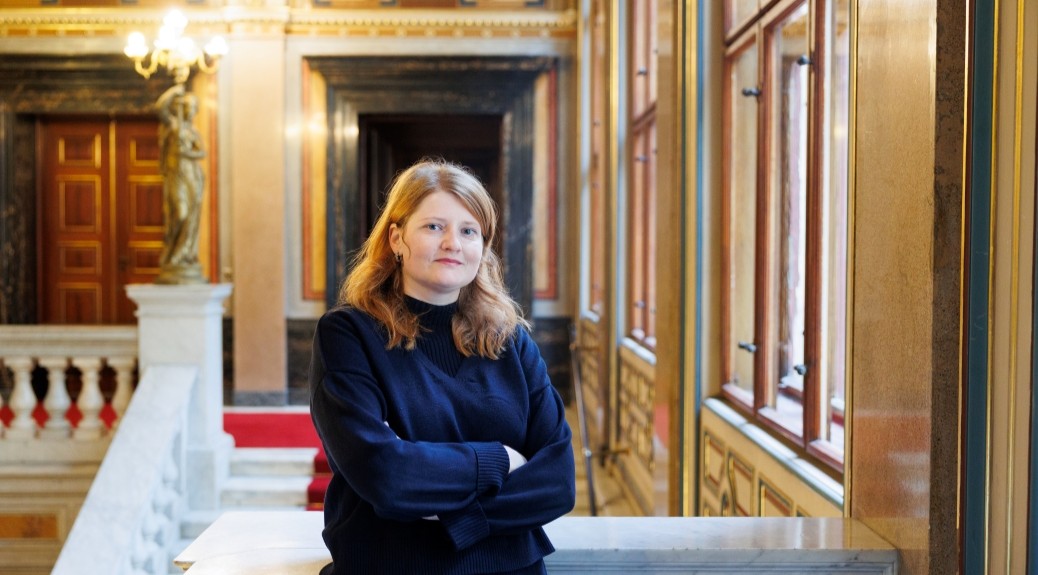
Trained across disciplines and shaped by moments when economic policy moved from abstraction to real-world consequence, Stephanie Ettmeier, PhD, Assistant Professor at CERGE-EI, brings a distinctive perspective to contemporary macroeconomics. In this interview, she reflects on her unconventional path into the field, her motivation for joining CERGE-EI, and the questions that animate her research—from the effects of fiscal austerity to new methods for understanding how aggregate shocks are experienced across households, firms, and regions. Bridging historical insight with cutting-edge empirical tools, Ettmeier’s work highlights why looking beyond averages is essential for both economic research and policy today.
What originally drew you into the field of economics, and what motivated you to join CERGE-EI?
I didn’t start in economics. I studied anthropology first, then political science – I was at Sciences Po Grenoble during the financial crisis. There were constant debates about economic policy, and I found myself frustrated. The discussions were often ideological, and I didn’t have the tools to evaluate the claims people were making. I realized that if I wanted to engage seriously with these questions rather than just argue from priors, I needed to learn economics – and specifically, I needed empirical skills to look at the data myself.
“Having a paper uninvited from a ministry seminar was oddly encouraging—it suggested the work might actually matter.”
As for CERGE-EI: it’s a US-style department with a good mix of macroeconomics and applied work, which fits what I do. It felt like the right place to start building my career.
From Disciplinary Frustration to Empirical Economics
Can you pick the influential moments in your academic journey?
A few come to mind. Once, a paper I was working on got uninvited from a ministry research seminar – apparently the topic was too sensitive. That was oddly encouraging. It suggested the work might actually matter.
On the other end, I’ve had the chance to present the methods I’m developing at central banks. Seeing practitioners engage with the work and think about how they could use it is rewarding.
“A policy that looks neutral in aggregate terms can fall very heavily on specific income groups, regions, or occupations.”
And it’s always nice when students or RAs you’ve worked with decide they want to pursue a PhD. Not because academia is the right path for everyone – it isn’t – but because it usually means they found something in research that excited them.
Looking Beyond Averages: Distributional Effects in Macroeconomics
In your recent work, you explore topics such as fiscal austerity, distributional effects of tax changes, and the historical evolution of wealth and inequality. What unites these topics for you?
The common thread is a simple question: when something happens at the aggregate level – a policy change, a crisis, a shock – who actually bears the consequences? Macroeconomics has traditionally focused on aggregates: GDP, unemployment, inflation. But these averages can mask enormous variation in how different households experience the same event. A tax reform that looks neutral in aggregate terms might fall heavily on certain income groups. A fiscal consolidation that “works” in terms of deficit reduction might devastate specific regions or occupations.
What ties these projects together methodologically is the need for granular information – by income group, by region, by occupation – and careful identification strategies that let us make causal claims. The specific data and setting vary across projects, but the underlying question remains the same: taking the tools of modern empirical macroeconomics and turning them toward questions about heterogeneity and distribution that the field has sometimes neglected.
Do you see any similarities from economic point of view between the era you focused on in your recent working paper Fatal Austerity and today’s reality?
There are striking parallels in the policy debates. In both periods, governments faced pressure to consolidate public finances during fragile economic conditions, and there were fierce disagreements about timing – whether austerity should come immediately or be delayed until recovery was secure. The distributional question was also present then as now: who bears the burden of fiscal adjustment?
But the differences are arguably more important. Brüning operated under the Gold Standard, which meant Germany had essentially no monetary policy autonomy. When fiscal policy tightened, there was no central bank that could offset the contractionary effects. Today, central banks have far more tools available – quantitative easing, forward guidance, emergency lending facilities. The policy space is fundamentally different.
The institutional constraints differed in nature as well. Brüning faced reparations obligations and international creditor pressure; today’s fiscal debates in Europe revolve around EU fiscal rules, which are rigid but not externally imposed in the same way.
And then there’s the political context. Weimar Germany was a young, fragile democracy – barely a decade old, without deep roots in political culture or established norms of democratic conflict resolution. Today’s European democracies are far more entrenched. That matters because it changes how economic crises translate into political instability. The room for radical political movements to exploit economic hardship is – one hopes – more limited when democratic institutions have had generations to consolidate.
Perhaps the most important lesson is simply that we know how the 1930s ended. That historical knowledge should inform today’s debates, even if the economic circumstances aren’t identical.
Could you describe one of your current “work in progress” projects — what question you’re trying to answer, and why it matters?
I’m working on a project that uses detailed Norwegian price data to study how the distribution of individual price changes responds to inflationary shocks. The method is a functional VAR – essentially a VAR that treats an entire distribution as one of the variables in the system, rather than just summary statistics like the mean.
The question we’re after is fundamental to monetary economics. When there’s an inflationary shock, do firms respond mainly by adjusting prices more or less frequently, or by making larger or smaller adjustments when they do change prices? This is the extensive versus intensive margin distinction. It matters because these margins have different implications for how inflation pressures build and whether high inflation creates significant relative price distortions across the economy.
“Combining careful data work with narrative methods gets us much closer to credible causal claims than running regressions on aggregate time series.”
We can also test whether firm behavior looks more like Calvo pricing – where the timing of price changes is essentially random – or state-dependent pricing, where firms respond to economic conditions. That distinction matters for how we think about monetary policy transmission.
It’s still very much work in progress, but I think the approach opens up new ways to connect micro price-setting behavior to aggregate inflation dynamics.
History, Methods, and the Challenge of Causal Inference
How do you handle issues of causality, data quality or measurement when dealing with long-run historical or cross-country datasets? Can you explain it on one concrete example?
In the “Fatal Austerity” project on Brüning’s fiscal policy during the Great Depression, we faced both challenges head-on.
For data quality, the key was assembling granular federal fiscal data that hadn’t been used before at this level of detail. That required a lot of archival work and careful harmonization -definitions change, recording practices varied. You spend a lot of time just understanding what the numbers actually mean before you can use them.
For causality, the challenge is that fiscal policy doesn’t happen in a vacuum. Brüning didn’t cut spending randomly – he responded to economic and political conditions. So we use narrative identification: we go through the historical record to understand why specific policy decisions were made, and we isolate variation that wasn’t simply a reaction to the current economic situation. This lets us distinguish the effects of austerity from the conditions that prompted it.
Neither solution is perfect – there’s always residual uncertainty. But combining careful data work with narrative methods gets us much closer to credible causal claims than just running regressions on aggregate time series would.
Given the global challenges we face (e.g., climate risk, financial instability, inflationary pressures), which aspects of your research do you think have the greatest relevance today?
The distributional focus. Whether it’s inflation, fiscal consolidation, or labor market disruptions – the aggregate numbers only tell part of the story. What matters for policy and for people’s lives is who gains and who loses. And to answer that, we need methods that take heterogeneity seriously.
That’s why I’m developing with colleagues what we call a csuVAR – a cross-sectional unit VAR – which lets us study how entire distributions respond to macroeconomic shocks. But it’s not just about modeling the whole distribution. The key is that we can zoom in and disentangle how different cross-sectional units – households, firms, individuals at different points in the distribution – are affected by aggregate shocks.
“You spend a lot of time just understanding what the numbers actually mean before you can use them.”
Take earnings. The standard approach in macro is to focus on white married men between 25 and 55, because their earnings trajectories are smoother and easier to model. But that throws away most of the population and most of the heterogeneity we actually care about. With our approach, we can model the entire distribution and trace how a recession, say, hits workers at different earnings levels differently.
The method is generic – it works for earnings, but also for opinions, consumption, or anything where you want to understand heterogeneous responses to aggregate shocks.
How do you hope your teaching and interaction with students at CERGE-EI will reflect your research interests?
The main goal is to empower students to carry out empirical research themselves – to answer questions that interest them.
My Applied Macroeconomics course covers both theory and empirical methods. We work through the models – how to think about labor markets, fiscal policy, aggregate dynamics -and then the tools to take those models to the data: time series econometrics, VAR models, bootstrapping. The two sides are integrated. You need the theory to know what questions make sense and what identification assumptions are plausible; you need the empirical tools to actually test them.
The methods I teach are the methods I use in my own research, so I can show students how these tools get applied in practice – what works, what’s tricky, where you have to make judgment calls. By the end, they should be able to take a question, find the right data, and work through the analysis themselves.
What research question or project are you most eager to pursue in the next few years?
I want to keep developing the csuVAR framework and turn it into a tool that other researchers actually use. Right now it’s still our project – but the method is generic, it can be applied to all sorts of questions about how distributions respond to aggregate shocks and who are the individuals, households, firms, banks etc. who are mostly affected by these shocks. Central banks would be natural users – they sit on a lot of micro data and increasingly care about distributional effects of policy. If people start picking it up for their own work, that would mean we built something useful. That’s the goal.

Outside of your academic work, do you have any interests or hobbies that help you recharge and possibly feed into your work in unexpected ways?
Quite a few. I row, I cook, I like being in nature. I try to maintain my social circle, which takes some effort when you move to a new city. I enjoy the contrast between Prague and getting out to the countryside. I think having a life outside work is important – research can consume all your time if you let it.
If you weren’t doing economic research, what do you imagine you’d be doing?
I have a few fantasies. Writing a book about how professors are depicted in film and literature – there’s something interesting about how that figure gets portrayed. Or running a small bar where I get to decide about the music and who’s allowed in. Or working as a forester, out in the woods.
But honestly, as a kid my dream job was to become a professor. Understanding how things work always fascinated me. So I’m not sure I have a real answer – I ended up doing what I wanted to do.
