
When Yaroslav Korobka, a CERGE-EI student with a deep passion for econometrics, received the unexpected suggestion “Princeton” during his DPW defense, it opened a path he hadn’t fully imagined. His mobility stay at Princeton University became a defining academic experience—shaping his research, expanding his network, and transforming both his skills and perspective. In this interview from the series Places You’ll Go, he shares what surprised him most about the teaching environment and the lessons he brought back for future CERGE-EI students.
Can you describe how you chose where you wanted to go, and why?
Discussion regarding mobility first came up after my DPW defense at the beginning of the third year. After each defense, the committee writes up a protocol about a candidate’s performance, including the idea’s relevance, quality of delivery, and overall performance. There is also a comment section for the committee to mention anything else; in my case, there was written “Princeton”, and that is when I found out what was the best place I could go according to the DPW’s committee. So, in this respect, I got a little bit lucky, since I already had a direction where to look at when thinking about mobility.
“It was fascinating to see how differently the same concepts can be explained. It’s like a new door opens into a room you already know.”
In my opinion, the most important criterion based on which a student should select a university, is existence of a faculty member whose work is close to your own. One of the main ideas why mobility exists is to go to some other place and exchange as many ideas as possible. Naturally, it is beneficial to have someone there who is a specialist in your area so that this ideas’ feedback is as efficient as it gets. Conditional that you found this person, it is, of course, important to find out whether he or she is available for hosting you.
In my case, it was Michal Kolesár, a leading expert in the field of robust econometrics. Because my research interests in high-dimensional econometrics were closely aligned with his, he was the best host I could find in Princeton. As a significant bonus, as I found out later, Princeton’s Department of Economics is a home to several leading experts in econometrics in general; this made my stay there much more pleasant and productive.
Teaching Styles: More Similarities Than Expected
How did the approach to teaching economics differ from what you were used to at CERGE-EI?
One of the most positively unexpected things I witnessed in Princeton was how close to CERGE-EI some of the courses were in terms of the topics covered, homework given, and style of teaching overall. I have been auditing several courses there, and in some respects, it was like I had not left CERGE-EI at all. Both there and here, at CERGE-EI, courses were relevant and with great emphasis on the developing research frontiers in economics.
Which courses and professors most significantly shaped your economic thinking?
The course on advanced applied econometrics taught by Michal Kolesár, and the course on nonlinear econometrics taught by Kevin Dano made a huge impression on me. Both courses were taught on a high-quality level and covered research frontiers in their respective areas. For me, having a lecture on a particular day was the main highlight of that day.
“Talent matters, but discipline and hard work matter even more. Princeton taught me that first-hand.”
Even though I already knew some of the things covered in those courses, it was fascinating to realize how differently same concepts can be explained by different people. It is as if a new door opens to a room that you are already familiar with. Being able to look at a problem from different angles is an incredibly important research skill that sometimes separates an average scientist from a leading professional.
A Thriving Research Environment
Was there anything about the university environment that suited you personally better than at CERGE-EI, and why?
What I appreciated the most in Princeton, was the number of faculty members and the number of fellow students I could discuss econometrics with. The Department was organizing weekly research seminars on econometrics, inviting speakers from leading places, as well as student research seminars on econometrics where students could present their research, at any stage of development, and obtain valuable feedback from the faculty. In both cases, it provided incredibly important understanding regarding research topics that were currently interesting for the scientific community in the econometrics’ field. As a result, the flow of ideas between the students and the faculty or among the students themselves was very productive and encouraging. This very narrow focus on econometrics inside the Department was something that I, unfortunately, miss a lot at CERGE-EI.
Which skills, both academic and personal, did you develop most during your time in the US?
One of the skills that I felt improved a lot during my stay is the ability to objectively evaluate added value of a specific idea. The ability to say whether the idea is worthwhile pursuing is being nurtured at top US PhD programs intensively. It makes perfect sense: you always have a limited amount of time allocated to a project and it is important to understand as soon as possible if effort invested is worth the result. One of the biggest mistakes I was making prior to my stay was being too focused on projects that even conditional on realized success would be marginal.
Another skill (that is, in fact, more of a habit) I would like to mention is discipline and hard work. Being in a place like Princeton can be mentally overwhelming and, in some cases, even depressing: almost every person you meet is incredibly talented and possesses wide knowledge about almost anything in your field. Be it a student of a faculty member, I was constantly amazed how fast and with easy they understood things or how much their intuition was developed. As a result, it might seem that conducting research for them is so much easier and requires much less effort.
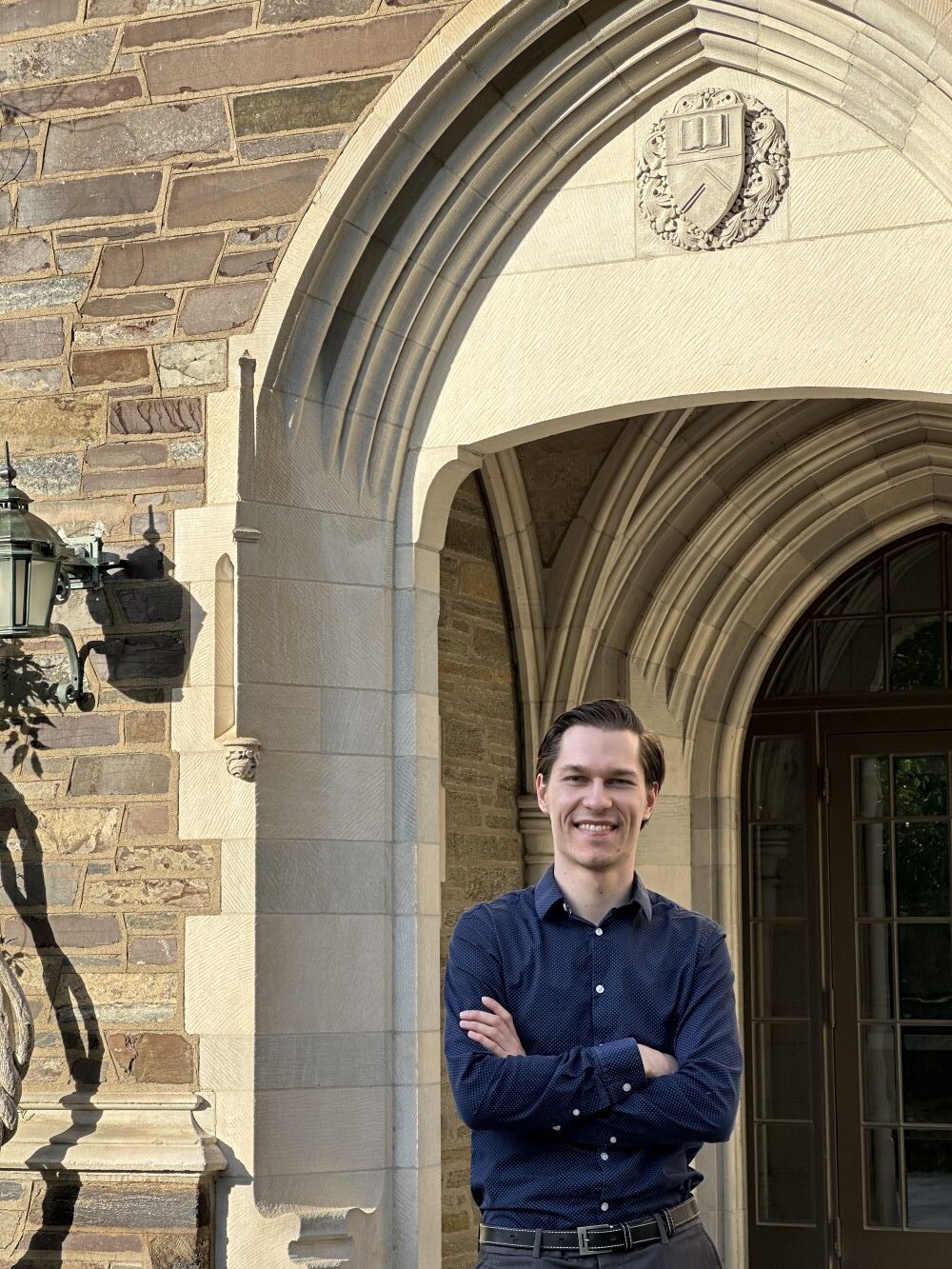
What I have witnessed is the complete opposite: even with all this talent, research (as any kind of work) requires a huge amount of discipline and hard work. Both professors and students seemed to be buried every day in their offices under piles of paper. Cumulative result of talent, hard work, and efficient feedback then produces papers that finish in top-5 economics journals and earn these institutions their reputation. What I found even more amusing, is that even with all this research, teaching, and pressure from the grant agencies, faculty members were always open to meet you to discuss your research (and find some time for their hobbies as well). This has taught me a real-life lesson how discipline and hard work (and, of course, non-neglible talent) can lead to outstanding performance without a complete sacrifice of personal life.
Advice for Students Choosing a Mobility Destination
What advice would you give to younger CERGE-EI students when considering where to apply for a study stay?
To any students that are considering going either to Princeton or some other place, I would highly recommend going to Princeton. You will absolutely enjoy living in a small student city, meeting interesting people inside and outside of the university, and you will almost surely learn something new, either for your personal or academic goals. As a small footnote recommendation, please, consider visiting a local cinema, Garden Theatre.
