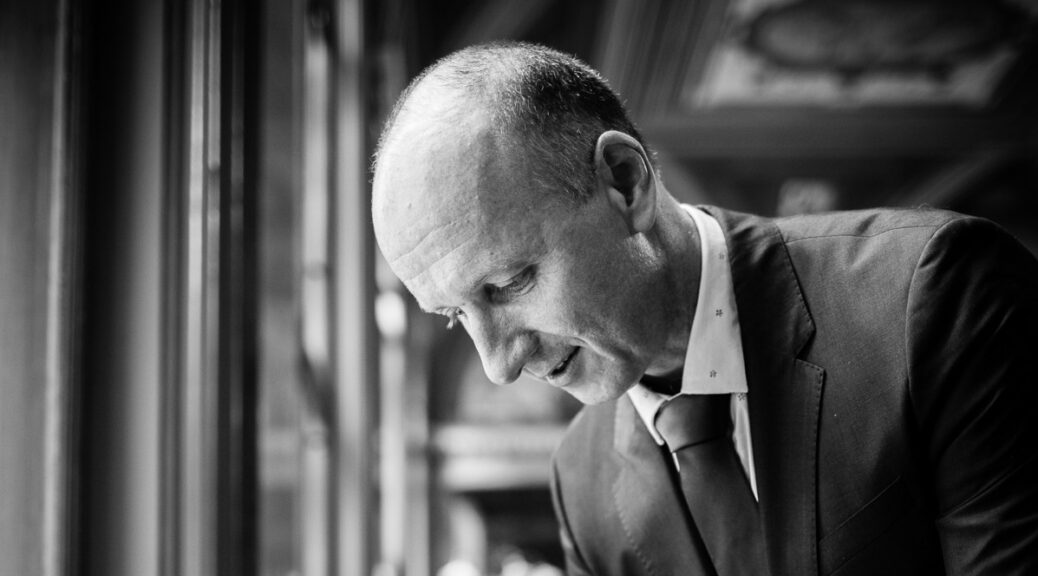
Our Phd alumnus, Viliam Druska, is Senior Director of Regulatory Economics at Ooredoo in Doha, Qatar. After starting out in a technical field, he transitioned to economics during the region’s shift to a market economy and went on to build a career in telecommunications. In this interview, Viliam shares the key choices behind his journey, explains what regulatory economics looks like in practice, and reflects on why balancing short- and long-term incentives matters for investment.
From Engineering to Economics
You originally studied a technical field. What motivated you to transition to economics and pursue a PhD at CERGE-EI?
When I finished my technical studies, Central and Eastern Europe – then still including Czechoslovakia – was going through a seismic shift from a planned economy to a market economy. Old trading links broke, new ones weren’t in place yet, output fell, and unemployment rose. In that environment, it became very clear that understanding how markets actually work wasn’t an academic luxury – it was a survival skill.
The labor market was sending a clear signal: we had plenty of engineers, but a serious shortage of economists trained in a modern, Western-style curriculum – and with strong English. I wanted to invest in my own “human capital,” broaden my options, and understand the logic behind the transformation.
That’s what took me to the U.S. first: to immerse myself in English, prepare for the TOEFL and GRE, and explore graduate programs. While there, I met Professor Jan Švejnar and some students from the early CERGE cohorts. Through them I realized CERGE-EI’s objectives matched mine: rigorous training, a Western economics curriculum, and an international environment – based in Prague, which certainly didn’t hurt either.
“Understanding how markets actually work wasn’t an academic luxury – it was a survival skill.”
I also discovered an unexpected bridge: many engineering ideas – systems thinking, modeling, and “control” concepts – translate remarkably well into economics. Different problems, similar tools. CERGE-EI gave me formal training in the foundations of a market economy, and it set me up for the next step. In my career, the combination of technical and economic training proved to be a real advantage.
Telecom as a Real-World Laboratory for Economics
You have built a long career in the telecommunications industry, first at Vodafone Czech Republic and now at Ooredoo Qatar. What initially attracted you to this sector, and how did your economics training prepare you for it?
Telecoms is not always the first place people imagine a PhD economist ends up. But it’s one of the best real-world laboratories for competition policy, network economics, and regulation – where economic ideas don’t just describe outcomes, they help shape them.
I also had a personal reference point. Under socialism, my family waited more than 15 years for a fixed telephone line, and we only got connected after the Velvet Revolution. Even pricing reflected scarcity: local calls were the only thing most families could comfortably afford, and “data connectivity” wasn’t even a household phrase. Today, someone can activate an eSIM in seconds and purchase an affordable roaming data plan that works seamlessly across the world. That’s not just technological progress – it’s a massive economic and social change, and telecom networks sit at the heart of it.
“Telecoms… is one of the best real-world laboratories for competition policy, network economics, and regulation.”
When I entered the labor market in the early 2000s, the sector was at the start of liberalization: new entrants were challenging the old monopoly model, and the rules of competition were still being written. I joined the third market entrant, working on network interconnection – ensuring customers of different operators can communicate. That sounds technical, but it’s deeply economic: large networks command market power, and without fair interconnection and competition rules, new entrants can’t survive.
CERGE-EI trained me to connect the dots: incentives, market power, network effects, pricing, and regulation. Over time, I applied those tools across roles – from competition and pricing questions to broader strategic and regulatory work. And as the sector became the foundation of the digital economy, that economic lens only became more valuable.
As Director, Regulatory Economics at Ooredoo Qatar, what are the core responsibilities of your role, and what types of regulatory or strategic challenges do you deal with most frequently?
My role – and my team’s role – is to help the company navigate and help shape the regulatory framework in a way that supports investment, innovation, and compliance. In practical terms, we focus on four areas: developing the company’s regulatory strategy, contributing to the state’s ICT policy discussions, securing scarce public resources (such as spectrum and numbering), and ensuring compliance to manage legal and reputational risk.
The strategic challenge underneath all of that is long-term investment. Telecom is capital-intensive and constantly evolving; networks require major, repeated upgrades. Regulation can either support that long-term effort or unintentionally undermine it.
A recurring theme is balancing short-term and long-term outcomes. Regulators understandably care about affordability today – economists would call that “static efficiency.” But if policy focuses only on the short term, it can weaken incentives and capacity to invest – “dynamic efficiency” – which ultimately drives service quality, resilience, and national digital ambitions.
So much of my work is about advocating for balanced, transparent rules that protect consumers while still enabling sustainable investment in the infrastructure powering the broader digital economy.
Telecommunications is a rapidly evolving industry. How have major technological transitions – such as 4G, 5G, and new digital services – changed the regulatory and economic issues you work on?
Telecom looks technical on the surface, but underneath it’s economics, politics, and infrastructure strategy. Every generational shift – 4G to 5G and beyond – quietly rewires the regulatory game.
4G enabled the explosion of over-the-top (OTT) services – apps that run over the internet connection (such as WhatsApp or Netflix) rather than being provided by network operators. Operators kept investing heavily in networks, but a growing share of value creation – and profit capture – shifted toward digital platforms. That raised new questions about competition, fairness, and how infrastructure costs are recovered when the “pipes” are regulated but the apps often are not.
With 5G and fiber, telecom networks became even more strategic infrastructure – supporting industry and public services and increasingly raising questions around resilience, data, and national priorities. As a result, regulation has expanded beyond classic telecom topics into digital policy more broadly, including platform dynamics, new connectivity models, and how to maintain a level playing field between licensed operators and digital players.
At the same time, older technologies (2G and 3G) are being phased out, and spectrum is reused more efficiently. That sounds technical, but it has real economic effects: it determines capacity, performance, and the cost of delivering modern telecom services.
Giving Back — and CERGE-EI at 35
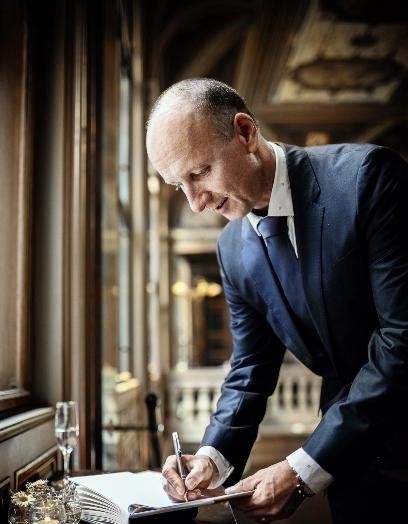
As a regular supporter of the Alumni Give Back campaign, what motivates you to contribute, and how do you see alumni philanthropy influencing opportunities for future students and the long-term strength of the CERGE-EI community?
CERGE-EI had a fundamental impact on my life. It expanded my opportunities, shaped my skills, and gave me friendships and professional connections that lasted well beyond graduation. When an institution does that for you, supporting the next generation feels natural.
During my dissertation phase, I also had the chance to spend time in the U.S., supported through CERGE-EI and local research collaborations. I still remember one of those “academic family tree” moments: only after arriving in Arizona did we realize that Professor Kmenta – one of my mentors at CERGE-EI – was connected through mentorship links to scholars I was working with there. It reminded me how knowledge travels through people, not just textbooks.
“Giving back feels less like charity and more like a responsibility – and honestly, a privilege.”
When you’ve benefited from that kind of environment, giving back feels less like charity and more like a responsibility – and honestly, a privilege. I was also deeply saddened by Professor Kmenta’s passing, and contributing to support his library at CERGE-EI felt like a meaningful way to honor someone who shaped my intellectual path.
More broadly, the Alumni Give Back campaign supports students so they can focus on study and professional growth – and alumni support goes beyond money, including mentoring and career advice. That combination strengthens the community in the long run.
CERGE-EI celebrates its 35th anniversary this year. What do you see as its key strengths and its role evolving in the years ahead?
It’s genuinely hard to believe CERGE-EI is turning 35. When it opened in 1991, it played a very specific historical role as a bridge – helping a region in transition build modern economic thinking and research capacity. Thirty-five years on, I think its key strength is still the same at the core: rigor, now with broader impact.
Institutionally, CERGE-EI’s model matters. As a joint workplace of Charles University and the Economics Institute of the Czech Academy of Sciences, it runs a demanding, internationally oriented PhD program built on strong theory, quantitative methods, and original research. That combination trains people to do more than solve problem sets: it trains them to think clearly under uncertainty and to separate correlation from causation.
That becomes even more important in the age of AI. Machines can crunch data fast, but they don’t automatically provide good explanations – or good judgment. The value of economics training that emphasizes causality and interpretation doesn’t go down; it goes up.
Looking ahead, I see CERGE-EI moving from bridge to beacon, especially through policy-relevant work like the IDEA think tank’s evidence-based approach to public debate. In a world full of noise, institutions that insist on rigor – and communicate it well – become increasingly important.
If the first 35 years were about catching up and building capacity, the next phase can be about leadership: producing economists who are as comfortable with data and modern methods as they are with messy real-world problems – and who can speak to both with clarity.
CERGE-EI changed my trajectory; I’m excited to see how it shapes the next generation’s.
