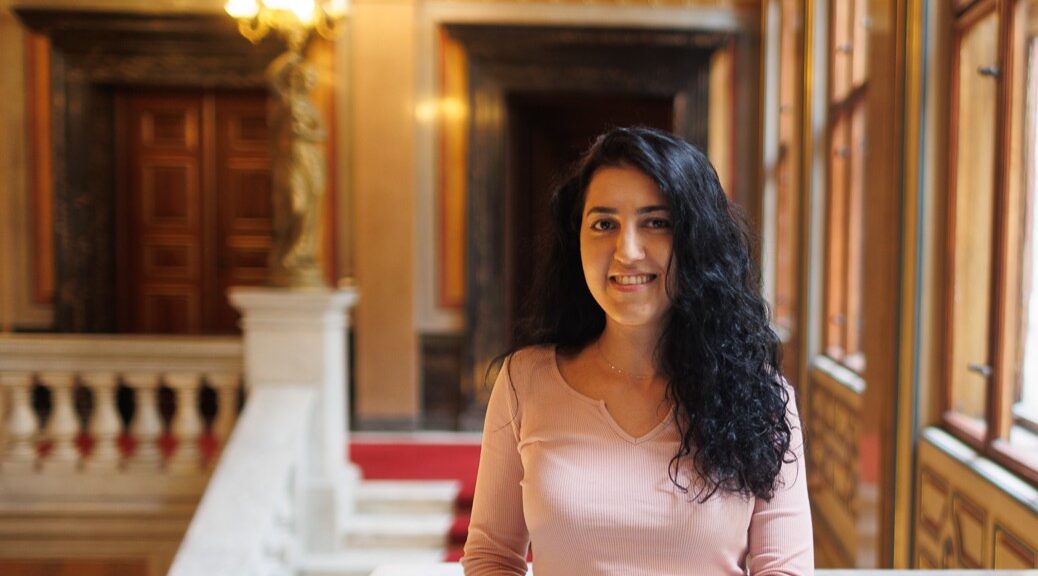
What starts as a single email can turn into a research-shaping journey. As Gayane Baghumyan, a PhD student and aspiring experimental economist at CERGE-EI, describes in this Places You’ll Go interview, it unfolded like this: a CERGE-EI–supported research stay became six months at the University of Chicago, hosted by John List, followed by a Stapleton Award–funded visit to Princeton and a conference stop at the New York Fed. Along the way, she discovered an intense seminar culture, world-class faculty who were unexpectedly down-to-earth, and “random conversations” that sharpened her research design and broadened her view of how economics can influence the world.
Can you describe how you chose where you wanted to go, and why?
I’m an experimental economist, and naturally, I wanted to be hosted by a professor with expertise in my area. I got the motivation for my first experiment from a paper by John List and coauthors, so I didn’t look far: I emailed him asking if he would host me, and he agreed. He’s at the University of Chicago, so that became my destination.
Three months became six: settling into UChicago
What was the process from the initial idea to actually landing in the University of Chicago?
I was always excited about the research-stay opportunity that CERGE-EI offers and supports. When the time came, I discussed possibilities with my supervisor, and he endorsed the idea —- so I started planning. First, I received the invitation from John List, my host at UChicago. Then I received financial support from GEOCEP and was also awarded the Stapleton Award. With that, I went to Chicago, started my journey there, and ended up staying for six months.
What expectations did you have before arriving to Chicago, and which ones were challenged the most?
I expected an elite school with a great curriculum and many smart people —- and it was exactly like that! The most challenged expectation was about the people; I think part of me expected more arrogance from world-class professors, but John List and others were super friendly and down-to-earth. Also, coming from very safe Prague, Chicago’s reputation felt ‘unusual’ at first, but the university and the friends I made there made me totally love it. Now, it’s one of my favorite cities.
“You can attend 2–3 research seminars a week that are directly relevant to your specific area.”
How did the approach to teaching economics differ from what you were used to at CERGE-EI?
Honestly, not too much. The academic level at CERGE-EI is quite high, so I was happy to find I could keep up with the classes at UChicago. The biggest difference was the sheer volume of seminars. J. List’s team, UChicago Economics department and Chicago Booth organize so many seminars that you can attend 2-3 research seminars a week that are directly relevant to your specific area. It’s a great environment for developing your own ideas.
“You’d be surprised how much a random conversation can shape your research direction.”
Were you involved in any research projects, seminars, or policy discussions outside regular classes?
Yes, I attended two classes connected to my research and several weekly seminars regularly. It was a great setting to present my own work, discuss new ideas, and give feedback to other researchers.

You received the Stapleton Award, which funded your study stay and an additional visit to Princeton University. How did this award shape your academic experience and opportunities?
The Stapleton Award hugely shaped my experience. It gave me the opportunity to visit Princeton, engage with faculty and students, and get valuable feedback on my research. Princeton really impressed me — the students are incredibly smart and the faculty is very friendly. I also got to meet Mr. Stapleton and his daughter, Wendy; that snippet of my stay was a real highlight.
During your visit to Princeton, you had the chance to meet CERGE-EI Foundation board members and prominent economists, including Jakub Kastl, Henry Farber, and Orley Ashenfelter. What were the most memorable conversations or insights you took away from these encounters?
Meeting the CERGE-EI board members was amazing. Everyone was kind, we discussed my research, they gave very useful feedback, and I left Princeton with a sharper identification strategy, and a serious research to-do list. Orley was especially memorable — we talked about research and life in Princeton over a glass of excellent wine. I’m very grateful for that experience.
New York Fed BEEMA7: comments that shaped the experiment
You also attended a conference at the New York Fed (BEEMA7). What was that experience like, and did it influence your research interests in any way?
While planning my Princeton visit, I noticed BEEMA7 was happening at the New York Fed. The agenda was close to my field, so I went to meet the presenters. I met Judd Kessler there, a professor at the University of Pennsylvania’s Wharton School; we discussed my research, and I ended up incorporating many of his comments into the experiment I ran last year — it directly shaped my design.
You had the chance to be present at Daron Acemoglu’s talk and book presentation for Power and Progress during your stay at Princeton. How did this event resonate with your own research or views on economic development?
It reinforced my view that technology is a tool. Acemoglu’s profound yet straightforward point is that technologies like AI don’t automatically benefit everyone; the benefits depend on who has the power to direct them. If elites use technology just to cut labor costs, we get innovation alongside inequality; if we push it to complement workers and create better jobs, we get prosperity. In fact, it’s the same core idea as his Nobel Prize-winning work with Simon Johnson and James Robinson — institutions and power determine who gets the gains.

Your planned three-month stay in Chicago expanded into a six-month experience after an invitation from John List. What was it like to attend his class on Experimental Economics, and how did the extended stay enrich your academic or personal growth?
The extension worked out great. His class was high-level and very practical. I deepened my knowledge of experimental techniques, which actually inspired the specific design I used for my last dissertation chapter.
You made friends not only in Chicago but also in New York. How did these personal connections shape your overall experience abroad?
Thanks to Tony Claudino, I met Galen and Mike in New York. They hosted me in their cozy house in Brooklyn, and we shared meals, deep talks, and even New Year’s fireworks. These connections, along with others in Chicago, made the experience much more enjoyable and provided a lot of warmth and joy.
How have your study-stay experiences influenced your future academic or career goals?
Greatly. I came back to Prague with a long to-do list! Seeing how John List contributes to both the academic world and industry — as Chief Economist at Walmart — broadened my horizons. It made me think about how we can influence the world through research in more than one way.
What advice would you give to younger CERGE-EI students when considering where to apply for a study stay?
I’d say: absolutely go for it. It’s an amazing experience, both academically and personally. It broadens your perspective, opens new doors, and gives you the opportunity to explore something completely new. You’d be surprised how much a random conversation can shape your research direction.

