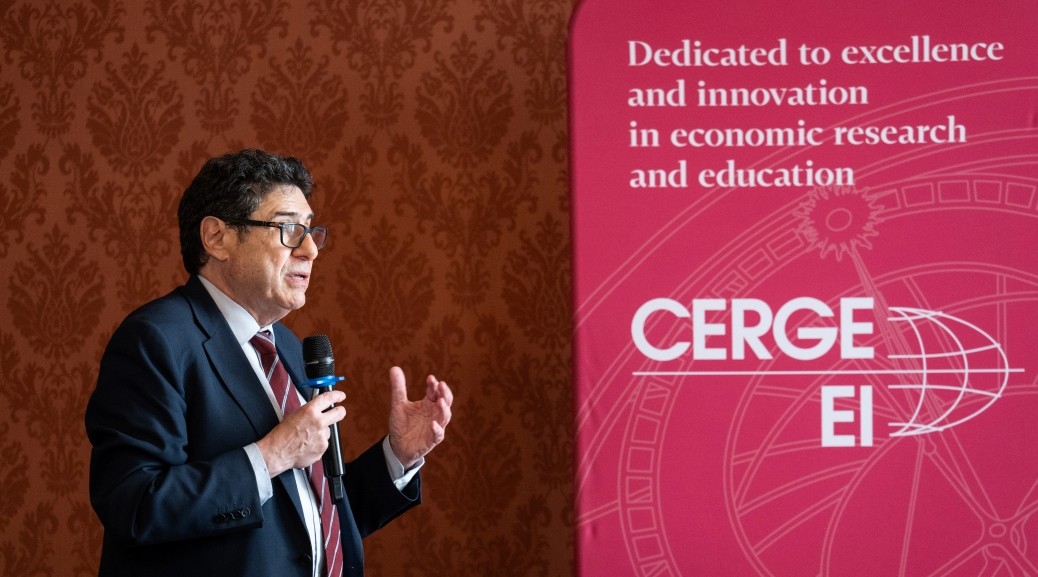
CERGE-EI welcomed Nobel laureate Philippe Aghion as part of its Distinguished Speakers Series and on the occasion of the institution’s 35th anniversary. During his visit, Charles University awarded him the honorary degree of Doctor of Economic Sciences, honoris causa, and he delivered a public lecture titled The Power of Creative Destruction: Rethinking Capitalism. He also met with students, alumni, faculty, and decision makers for academic discussions and exchanges. In this student interview, Professor Aghion reflects on his own path from mathematics to economics, the social motivations behind his research, and the areas he believes will offer the most meaningful opportunities for young economists and PhD students today.
You were part of CERGE-EI’s story from the very beginning, when the institution was founded during the early years of the economic transition. Looking back 35 years later, what does it mean to return here and see how CERGE-EI has developed?
It is quite emotional for me to be back here at CERGE-EI in the year when you are celebrating the institution’s 35th anniversary.
I remember when I was approached by Jan Švejnar 35 years ago to sit on the advisory board of this new institution, which was meant to become the leading economic research center and economics department in Central and Eastern Europe. I remember those moments very clearly. We had this great ambition to build excellence in economics in a former socialist economy, and that is how CERGE-EI was created.
It was also the time of the first days of the transition to a market economy. So to come back 35 years into this transition and to see the huge success that CERGE-EI has become is quite emotional for me. I am very honored and humbled to have been asked to be part of the founding team of CERGE-EI.
Let’s look back at your early career. You started by studying mathematics and then moved into economics. What led you to make that transition?
You may laugh, but I was a political activist in the French Communist Party. Of course, the French Communist Party was quite different from the Czech Communist Party. This was after 1968, and many of us were involved in leftist movements.
I wanted to make the world a better place. Poverty was an obsession for me, and in many ways it has always remained one. Given that I was politically engaged and had learned mathematics, economics felt like a natural path. When you are socially motivated and you know some mathematics, economics becomes a way to address major questions, such as how to help a country escape poverty.
That is why I went into growth economics. I was not afraid of models, because I had a mathematical background. It was really the combination of mathematical training and political motivation that led me into economics.
I should add that I am no longer a communist. I would describe myself today as a good social democrat.
If you had one piece of advice to give to PhD students about doing meaningful research, what would it be?
Meaningful research is important. I think there are several areas in economics today where very important work can be done.
Growth, development, and productivity are still central fields. There is a lot happening in growth policy and growth economics. To work in these areas, you need to learn good microeconomics, and you also need to be strong with data. You need to be comfortable with modeling, with calibrating models, and with empirical work. There are now very good and interesting datasets available, and there is a lot to be done.
Another important area is inequality and redistribution. There will continue to be a great deal of work in that field.
Behavioral economics is also very interesting, and I think there will be a lot of activity there as well.
I also believe that artificial intelligence, especially its consequences for the labor market, will become a major topic. Questions such as how to make AI beneficial, which jobs will be created, which jobs will disappear, and how organizations should adapt to AI will all become very active areas of research.
Trade economics is another important area. In the past, global value chains were largely based on cost minimization. Now, resilience will matter much more. Understanding how economies and firms make that transition will be an important topic.
So my advice would be to choose a field where important questions are being asked, and then make sure you have the tools — both theoretical and empirical — to answer them well.
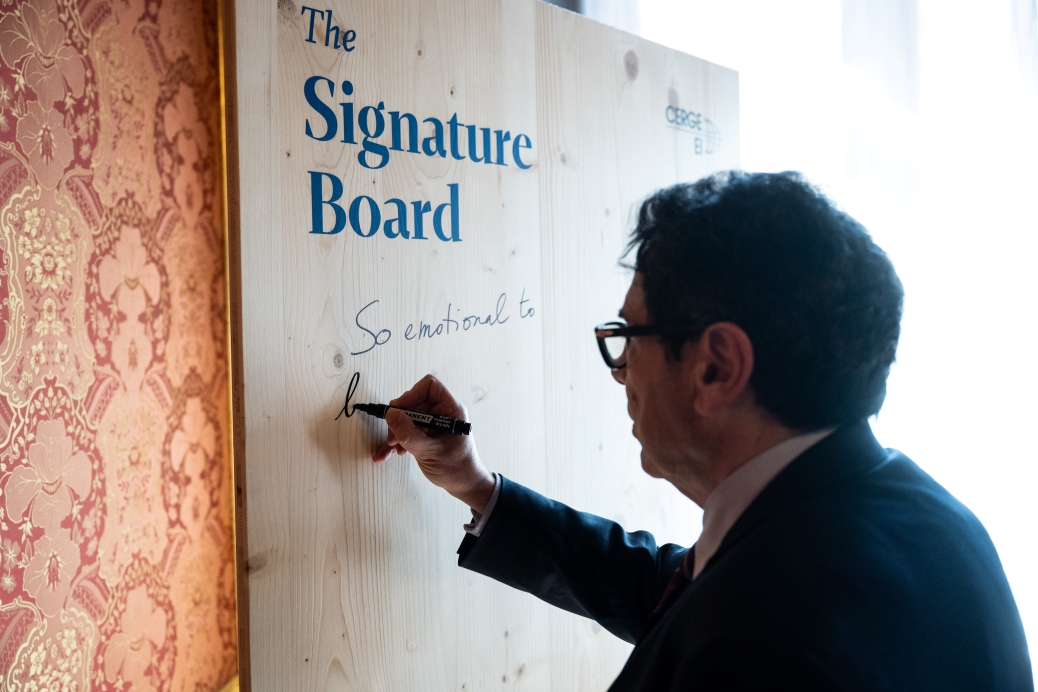
Explore the photo galleries from the honorary doctorate and public lecture.
Watch the public lecture The Power of Creative Destruction: Rethinking Capitalism.

Good for Poor