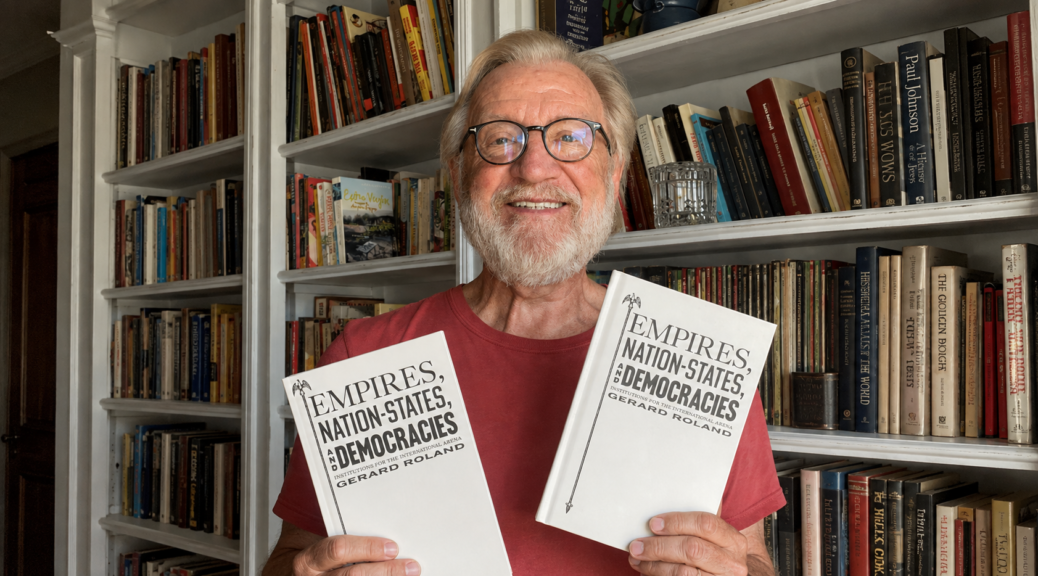
In the new book Empires, Nation-States, and Democracies, Gérard Roland argues that the great political struggle of the coming decades will not simply be between democracy and authoritarianism, but between competing models of political organization: empires, ethnic nation-states and open democracies. In this interview, he explains why nation-state projects ultimately collide with democratic values, why Russia and China face structural vulnerabilities, why American retreat could reshape the global order, and why he remains optimistic about democracy’s long-term future despite today’s democratic backsliding, wars and geopolitical instability.
In your book, you focus on three political systems: empires, nation-states, and democracies. What led you to draw this distinction, and does this framework encompass all existing political entities?
Empires are a fairly obvious category. The other distinction has to do with the collapse of the Soviet sphere of influence after 1989. In some countries, the liberation from the Soviet empire was seen as an opportunity to build an independent nation with no foreigners, i.e. a “pure” Hungarian or Polish nation. Others saw this liberation as an opportunity to introduce democracy and the market economy. The former are those wanting to construct nation-states with ethnic homogeneity within the country’s borders, the latter are those wanting their country to become a full-fledged democracy. The former pursue the nation-state projects, the latter democracy. These two tendencies are strongly present in all post-communist countries in Central and Eastern Europe. What I emphasize is that in the long run, you cannot have both. You must choose: either the nation-state or democracy. My distinction between these three entities does not cover all forms of polity. I make that very clear in the book. Nevertheless, I discuss whether these other forms (failed states, non-imperial autocracies) will lean in one direction or the other. Here, I think democracy has much more future in these other polities than the nation-state, especially in Africa where there is a lot of ethnic diversity within countries.
You mention that nation-states were once “progressive” when they emerged from the collapse of empires but have now become a project of the “extreme right.” Was there a specific economic turning point that triggered this shift?
I do not think that there is an obvious turning point. If nation-states emerging from empires do not go in the direction of democracy and openness, then they do indeed become reactionary. Look at the big cities in today’s world like New York, London or Paris. They are both completely multi-ethnic but also economically very successful. This success is completely denied by the extreme right that has the fantasy of turning modern cities and countries into mono-ethnic polities. This is not only a fantasy (such mono-ethnicity never really existed) but goes against economic progress.
Freedom Is an Economic Advantage, Not Just a Political Value
You argue that empires are doomed because people with “high human capital” cannot be forced to be highly productive. How do you view modern authoritarian regimes that attempt to use technology and surveillance to maintain productivity while restricting freedom?
Restricting freedom is terrible. Freedom is one of the most important values people have. It has intrinsic value. Moreover, in a world where human capital is the main source of growth, one cannot force people to use their human capital optimally. Regimes like China try to compensate this by putting more money into research. The problem today is that Trump is attacking science and American universities. That plays to the advantage of China, but in the long run, their inefficiencies will accumulate. Take AI. LLMs learn less if they are exposed only to censored data. Democracies should take advantage of the benefits given to them by openness, freedom and rule of law.
Can Democracy Transcend Ethnic Conflict?
You suggest that Israel cannot remain both a “Jewish state” and a “democracy” in the long run. In your framework, what would a “small democracy” model look like for this region, and is such a model possible without the ethnic cleansing or theocracy you describe?
The answer is obvious: a democracy where ethnicity does not matter. I am well aware that given the current situation where one has two groups that want to kill each other, this will not work in the short run. Nevertheless, is there an alternative besides ethnic cleansing of one side or the other? I do not think so. Peace is the only humane solution and reasonable people realize that there is not really an alternative, but when will their voice be strong enough? Right now, there are not really any reasons to be optimistic.
What Happens When Empires Begin to Break Apart?
You predict the possible breakup of the Russian and Chinese empires following military defeats. Drawing on your experience studying post-communist transitions, what would be the greatest economic risks to the global economy if these two major powers were to suddenly decentralize or collapse?
People mention the danger of nuclear weapons being held by breakaway regions. This was also a problem after the collapse of the Soviet Union. It will be a problem in case of a collapse of the Russian empire, but the answer is not to support the Russian empire but to prepare so as to minimize the damage from a breakup of the Russian Federation. China is still an ascending power, so a breakup is unlikely right now. Nevertheless, imagine that they try to invade Taiwan and fail. This could lead to a collapse of the communist regime in China and to secessionist tendencies in China’s Western half. All this carries economic risks, but again, supporting mortally wounded empires will not be a solution.
What are the main facets of American imperialism today from an economic point of view?
One sees the bullying of allies and the flattering of autocrats. The danger is a world divided into three spheres of influence: the US over the Americas, China over Asia and Russia over Europe, the rest (Africa) being fought over between the three. Trump is actively pushing in that direction and the harm done to American allies will be hard to undo. Trust will likely not come back any time soon and that has dire economic consequences in terms of international trade and investment.
An America Turning Inward
While you do not predict a breakup of the U.S., you suggest that the presidency will be “strongly constrained,” with more power shifting to the states. How would this internal decentralization affect the ability of the U.S. to lead or participate in the “supranational organizations” you advocate?
The reason I do not see a breakup of the US has to do with many factors; strong factor mobility within the US and also federalism. The most likely scenario is that isolationist tendencies will dominate and the US will retreat more and more from the international community, leaving mid-sized countries alone to face the Russian and Chinese empires.
You cite the EU as the primary example of small democracies living in peace. What is the most critical institutional hurdle facing other regions, such as Africa or Latin America, that seek to replicate this supranational framework?
It is difficult to make predictions here, but the idea of some supranational Latin America or Africa exists already. As long as those countries do not develop into mature democracies, it is unlikely to happen in my view, but this is in my view the best direction for the future.
The Answer to Economic Anxiety Is Redistribution, Not Nationalism
You argue that “economic nationalism” is harmful because it rejects openness to trade and immigration. How should democratic leaders address the underlying economic anxieties of voters who feel left behind by globalization without resorting to the “nation-state” project?
Indeed, this is critical. One problem is that inequality has been increasing in advanced democracies and the welfare state is under attack. Nevertheless, reinforcing the welfare state and fighting inequality are much better answers than stoking nationalist hatred towards others, which will only bring conflict and misery.
While your latest book Empires, Nation-States, and Democracies focuses on institutions, your previous work with Yuriy Gorodnichenko emphasized culture. Does a “culture of democracy” need to be firmly established before your proposed institutional changes can succeed, or can the institutions themselves help create that culture?
It is not just a culture of democracy, it is firm support for the values of the Enlightenment: human rights, equality before the law, freedom, judicial independence, democracy, etc.
Why the Democratic Retreat May Be Temporary
You offer an optimistic message that, in the long run, a world of peace and supranational cooperation will prevail. Given the current “retreat” of democracy, what leading indicators should we look for to know whether we have finally turned the corner toward this world of small democracies?
I think that the current retreat of democracy is temporary. It has much to do with the crisis of democracy in the US brought about by Trump but that existed before. The evolution of the US is a key factor, obviously, but also the retreat of Russia. China will remain an empire in the ascendant for a while unless it tries to invade Taiwan, which can bring bad surprises, but it is possible to live with China as long as one engages in de-risking and does not become economically dependent on China, because that would inevitably imply a loss of sovereignty as China would make more and more demands “difficult to refuse.”
For several years, we have been experiencing an ongoing “polycrisis” driven by the climate crisis, global instability, trade wars, and military conflicts. What are the sources of your optimistic view of the future of democracy?
The climate crisis is very serious and there is no silver bullet right now to solve it. Look, I experienced the Berlin Wall being put up when I was a child. I experienced 1989 and all the changes in Central and Eastern Europe that would have seemed impossible a few years before. Economic progress and progress in education make people want to live in a democracy above anything else. Do people in Slovakia really want to go back to Soviet times? I don’t think so. Look at how Ukrainian people are fighting for their freedom, and they are getting better and better at it. When you live under democracy, you take it for granted. If you live under dictatorship, democracy is a dream you want to fight for. People will continue fighting for it.
