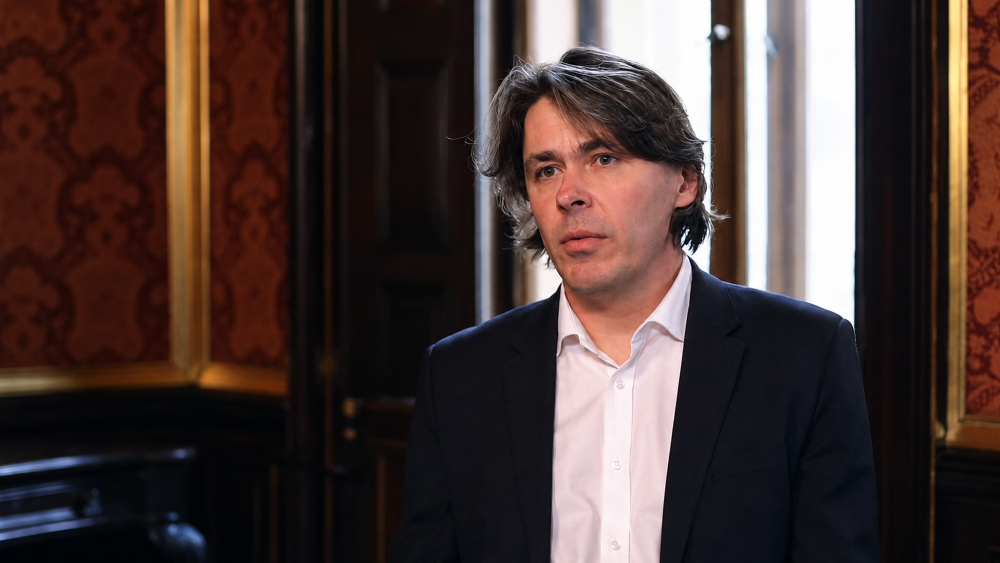
In this interview, Radim Boháček, PhD. (CERGE-EI) discusses a Czech-Swiss project developing smartphone-based tools for the early detection of neurodegenerative diseases as part of the neuroSHARE project, titled Remote Assessment of Neurodegenerative Diseases and Dementia. The broad collaboration includes members of the neuroSHARE research team — Vojtěch Illner, PhD., Pavla Mašková, Jan Rusz, PhD. from CTU FEL – Czech Technical University in Prague, Faculty of Electrical Engineering, and Petr Dušek, MD, PhD. from the First Faculty of Medicine, Charles University — as well as partners from Université de Lausanne (UNIL) and the Swiss Centre of Expertise in the Social Sciences (FORS).
The project Remote Assessment of Neurodegenerative Diseases and Dementia in SHARE brings together social science, medicine and technology. Can you describe its origins?
The idea grew out of a cooperation between researchers working on ageing surveys, neurologists, medical doctors and biomedical engineers. Within SHARE, the Survey of Health, Ageing and Retirement in Europe, we already collect detailed data on ageing populations. But we wanted to go further and develop innovative tools that could capture early signs of neurodegenerative diseases, especially Parkinson’s disease and Alzheimer’s disease.
From Clinics to Smartphones
The first step was taken in the Czech Republic, where we tested these tools in SHARE Wave 10. That meant bringing methods originally used in clinical settings into a large population-based survey. The experience went surprisingly well, and it opened the door to the next step: making these tools remote, more accessible and internationally usable.
The cooperation with Swiss partners is very important here. Switzerland offers a multilingual environment, which is ideal for testing whether such tools can work across languages and contexts. Our broader aim is to develop an automated, harmonized and open tool that can be used internationally.
What is the ultimate goal of the project?
There are several goals. From a research perspective, we want better and more precise data. Future survey data will increasingly be linked with administrative and health records, so we need new research-based measurements that governments or official systems do not currently have.
But there is also a very practical public health goal. We want to develop simple remote tools that can detect warning signs of neurodegenerative diseases in the broader population. The tool would not replace doctors or provide a final diagnosis. Rather, it could indicate that someone shows early signs that should be assessed by a medical expert.
In practical terms, the tool could one day tell a person: based on these tests, there may be signs of early neurodegeneration, and it would be advisable to see a doctor. That is the public purpose behind the research. All research ends up in some practical way at the end, right? Sometimes you wait for the right government to come. Sometimes it happens in years.
Why Early Detection Matters
Why is early detection so important?
Neurodegenerative diseases such as Alzheimer’s and Parkinson’s are already a significant burden. In the Czech Republic, more than 100,000 people live with Alzheimer’s disease, and Parkinson’s disease affects about 30,000 to 50,000 people. These numbers are rising, partly because European societies are ageing, but also because of other factors that are not yet fully understood.
The major problem is that people are often diagnosed very late. By the time major symptoms appear, treatment options are much more limited. If these diseases are detected earlier, there is more space to intervene, adjust treatment, support the patient and prolong active life.
We are therefore interested in subtle markers that may appear before people themselves realize something is wrong. These signs can be very small, but if detected early enough, they may make a real difference.
What exactly are you measuring?
We are looking at several domains. Speech is one of the most promising. We analyse how people speak, including subtle acoustic patterns that may reflect changes in the vocal tract or motor control. We are also interested in language itself.
In addition, we are testing facial movements, such as how people move their eyes, cheeks or other parts of the face. We are looking at colour vision, because impairments there can appear early. We also examine hearing patterns and sleep patterns, since certain sleep disturbances may be risk factors for neurodegenerative disease.
What’s important is that each of these tests is very simple to perform, but what’s really powerful is a combination of these tests.
How does the remote version work?
The goal is to make the tests smartphone-based in the form of a web application. Respondents would not need to install anything. They would open a web link, and the application would guide them through the tasks.
This is a major change from previous clinical or face-to-face settings. In a clinic, experts guide the patient. In a survey, trained interviewers can help respondents. But in a fully remote setting, the person is alone with their phone. That means the whole process has to be redesigned.
The instructions must be very clear, especially because the target population includes older people. The interface has to be user-friendly, understandable and ideally even pleasant to use. We also have to deal with technical challenges, because people use different smartphones, operating systems and settings.
Simple Tests, Stronger Signals
Does the tool require any special equipment?
No, and that is one of its main advantages. The tests are non-invasive and use features a smartphone already has. For speech, the person talks to the phone via a microphone. For hearing, sounds can be played by speakers. Facial movements are assessed using the phone camera. For vision, the screen is used. For questionnaires, the person simply answers questions.
There is no need for blood samples, sensors or specialised medical devices. That makes the approach low-cost and largely scalable.
How did the project move from the clinic to the broader population?
The work began more than ten years ago, when neurologists and bioengineers led by Dr. Jan Rusz examined patients’ speech and other markers in clinical settings. Around three years ago, the team moved these methods into the Czech SHARE survey. That meant adapting clinical tests to face-to-face interviews with older respondents.
This was already a major step. Interviewers had to be trained to administer standardised tests, and the process had to work outside a hospital. Now the project is moving one step further, from face-to-face interviews to remote smartphone testing.
This transition is not simply a technical adjustment. The entire framework has to be reworked, because the tests must function without an interviewer and without a controlled environment. To put it simple, the next step is to make tests more accessible, cheaper, remote, using the new technologies, which 10 years ago were not reliable or even available.
You mentioned the Czech SHARE survey. Explain the role of SHARE in this project.
SHARE is a European research infrastructure focused on ageing. It is part of a broader family of ageing surveys, including the Health and Retirement Study in the United States and similar surveys in countries such as England, China, India and Mexico.
These surveys are harmonised, which means they use comparable questions and methods. That makes it possible to compare ageing processes across countries.
SHARE itself is organised as a European Research Infrastructure Consortium, hosted in Germany. Individual countries participate, contribute funding and collect data nationally. The research agenda is developed jointly by country teams and coordinated centrally to ensure comparability.
How is the data handled, especially given the sensitivity of health information?
Data protection is a major issue, and it is managed through SHARE’s established systems. Interview data are transferred securely to the central SHARE data management office. The data are anonymised and then made available to researchers.
For example, when we analyse speech, the recording is assessed through dedicated automated algorithms which extract numerical parameters. These numbers correspond to physiological features of voice production or language patterns. Researchers then work with those anonymized numerical vectors rather than raw data.
The important point is that these test results can be linked with other SHARE data: education, work history, family situation, health, activities, beliefs, cognition and previous survey waves. That allows researchers to study long-term pathways that may lead to early warning signs of diseases such as Parkinson’s.
The Role of Swiss Cooperation
What is the contribution of Swiss partners in the project?
The Swiss partners are essential for several reasons. First, Switzerland provides a multilingual setting, which is crucial for developing a tool that can work internationally. The project can test versions in different languages, including German and French.
Second, Swiss colleagues bring expertise in public research, logistics and implementation. They help test the application, improve the design and refine the instructions so that respondents understand the tasks in the same way. To have an optimized test design which respondents understand, which motivates them, and which ensures proper following of the tasks instructions is one of the most essential parts of the whole project.
The cooperation is mutual. The Czech side brings experience from the previous NeuroSHARE work and from adapting tests to survey settings. The Swiss side contributes its own expertise in multilingual public research and implementation.
What stage is the project at now?
The smartphone web-application is already in an advanced stage of development and is being tested. The team is working with Swiss colleagues to refine the design, instructions and user experience.
The next step is pilot testing in the Czech Republic, planned for late summer or autumn. This pilot will collect user feedback and assess how the data looks when people complete the tests remotely in different environments.
After that, the tests will be adapted and translated for the Swiss environment. They will be tested again across different languages before the main data collection.
So when will they be available to broader public?
The state of the methodology is in the research phase. The neuroSHARE Remote is the first project to remotely investigate early neurodegeneration markers in population sample. This means the acquired markers are still experimental. More focus will have to be put on validating the markers in terms of clinical relevance. What works on the clinic might not work on smartphones at respondents’ homes. This is something that must be heavily studied and it will probably take several years before the remote markers are validated. After that, we hope the tools will be validated and available for public use.
What are the main risks of the project?
The project is still experimental. We do not know of another project doing this at the same scope, so we are entering partly unknown territory.
One risk is that markers that work well in a clinical setting may behave differently when collected through smartphones at home. Speech, for example, is very sensitive in a controlled environment, but remote testing introduces background noise, different devices and different ways of completing tasks.
That is why validation is so important. In the Czech pilot, respondents will first complete the tests remotely and then repeat them in a standardised controlled setting. The team can then compare the results and adjust the tests.
Another major risk is participation. The tool depends on people being willing to take part. Even when tests are simple, people may be afraid, uninterested or reluctant to know whether they might have early signs of disease.
Why would people want to take such tests if there is no cure for these diseases?
There may not be a cure, but there are treatments and interventions that can improve quality of life. In many diseases, starting treatment earlier leads to better outcomes. Early detection also allows people and doctors to plan and respond sooner.
The team sees this as part of preventive medicine. Just as governments encourage cancer screening, they could one day encourage early screening for neurodegenerative diseases. Public information campaigns and incentives may be necessary, because people do not always take preventive tests even when they are useful.
What Comes Next
Could these tests eventually be used outside Europe?
Yes, that is part of the long-term vision. In Europe, health systems already have hospitals, specialists and definitions for diseases such as Alzheimer’s and Parkinson’s. But many countries are only beginning to face large-scale population ageing.
In countries such as India, the ageing population is growing rapidly, and health systems may not yet have sufficient infrastructure, specialists or even established diagnostic pathways for these diseases. A low-cost, remote screening tool could therefore be especially valuable.
However, governments would still need expert support to use such tools properly. Researchers can develop and validate the methods, but implementation requires health policy, funding, incentives and local adaptation.
What would be the best possible outcome?
The ideal outcome would be a standardised, thoroughly tested methodology for remote screening of early neurodegeneration. It would be open, accessible and usable internationally.
It could raise awareness of neurodegenerative diseases, inform health policy and help individuals seek medical advice earlier than they otherwise would. It could also support future research, because the tool can continue to evolve as new technologies, devices and biomarkers become available.
The current project is one step in a longer process. It began in clinics, moved into face-to-face population surveys, and is now moving to smartphones. In the future, it may include new devices, wearables and additional tests.
Is the project intended to become a commercial product?
No. The philosophy behind the project is open science. The tools and data should be open and useful to other researchers. The team expects that others will adapt and further develop the approach.
The advantage is in moving first, building expertise and validating the methods carefully. But the broader aim is public benefit.
What does the cooperation of experts with diverse backgrounds bring to the project?
The cooperation brings technical, medical, survey and implementation expertise together. It also forces the team to think beyond technical details and consider how the work can become publicly useful.
International cooperation is especially valuable because a tool like this cannot be designed only for one national context. The Swiss partnership helps the Czech team test whether the approach can work across languages and settings. At the same time, the Czech experience from earlier NeuroSHARE testing gives Swiss partners a strong basis to build on.
The project is therefore not only about developing an application. It is about mutual learning, standardisation and creating something that can eventually serve researchers, health systems and the public.
The project Remote Assessment of Neurodegenerative Diseases and Dementia is supported by the Swiss–Czech Cooperation Programme.
